Is Turin’s Borgo Medievale really medieval?

Turin’s Borgo Medievale looks back to the Middle Ages, but it was created in 1884. That distinction makes it more interesting, not less. The buildings tell a story about medieval architecture and about the nineteenth-century people who wanted visitors to understand, admire and preserve it. You are looking at a carefully assembled interpretation of the past, rather than a village that has stood beside the Po since medieval times.
There is also an immediate planning point. When checked on 10 October 2026, the City of Turin’s visitor page still described the complex as closed for works within the Parco del Valentino project. Do not build a day around entering it until the city confirms access. A projected year for completion is not a reopening notice.
Start with the exhibition, not a castle legend
The city explains that the Borgo began as the Ancient Art pavilion of Turin’s 1884 National Exhibition. Alfredo D’Andrade led the group behind a project drawing on medieval buildings in Piedmont and the Aosta Valley. Its subject was regional architectural heritage: houses and defensive structures, along with the details that helped give them character.
This is different from moving one complete old settlement into a park. The Borgo brought references together to make a legible encounter with a historical world. When you see a photograph, ask which details belong to the represented period and which choices belong to the people arranging the exhibition. The second question does not spoil the first. It adds another layer of history.
Look for the decisions behind the atmosphere
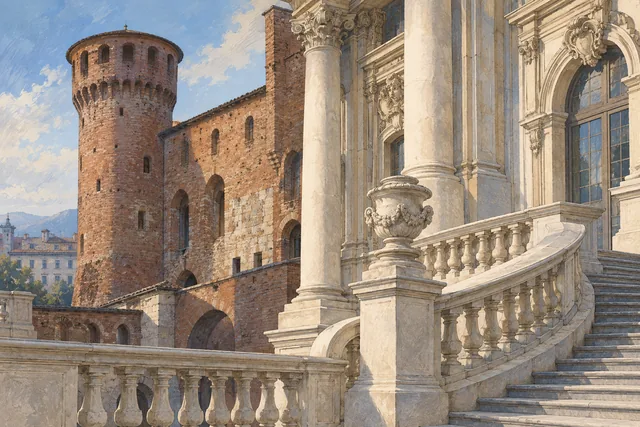
A gateway can make you feel that you are crossing into another time. Rooflines, the scale of openings, the contrast between stone and timber, and the way a street turns all contribute to that effect. Try separating those ingredients. Which part creates a sense of enclosure? Which gives you somewhere to look next? Which detail could be studied as an individual piece of design?
You can practise this kind of looking elsewhere in Turin. Our guide to Palazzo Madama’s different historical layers considers a building whose changes accumulated over time. The contrast is useful: a surviving structure with successive adaptations and an exhibition ensemble can both teach history, but they provide different kinds of evidence.
A reconstruction can become heritage in its own right
The Borgo also belongs to the history of exhibitions, restoration and public education. Its nineteenth-century creators made judgments about what should represent the region. Those judgments deserve attention alongside the older buildings that inspired them. Authenticity is therefore a question to define carefully: authentic evidence of which period, practice or idea?
The city’s announcement about conservation and future use places the complex within an ongoing project. That is a reminder that heritage is maintained through present-day decisions as well as inherited from the past. Older announcements may explain intentions, while the current visitor page should guide decisions about access.
Make a workable Turin day while it is closed
Choose an open, independently confirmed attraction as the day’s anchor. A museum, a guided city walk or a relaxed central itinerary gives the group something concrete to enjoy. Our one-day Turin route can supply that structure. Avoid adding a cross-city detour simply to discover that a gate remains shut.
If time beside the river appeals, use our River Po and parks guide as a starting point and check current works, entrances and diversions before setting out. A park’s general presence on a map does not confirm that every path is available. Allow the route to change with conditions and the group’s comfort.
Carry the question into another city
The relationship between historical evidence and later imagination is a rewarding travel theme. If Milan is also on your itinerary, the Bagatti Valsecchi story offers another way to think about nineteenth-century enthusiasm for earlier styles. Treat it as a comparison between different projects, not proof that they had identical aims.
Browse our Turin history experiences when you want a guide to connect places and ideas. Read the actual itinerary and inclusions before booking; a reference to medieval Turin does not promise Borgo admission. The most useful visit is one that understands what is available today while leaving room to ask thoughtful questions about how the past is presented.
Sources & further reading
Turn a good read into a great day.
Find a highly rated Turin experience that brings these stories to life.
Explore related experiences →