Turin’s Piazza Statuto: how do you read a square and its railway-tunnel monument?

Piazza Statuto is a good place to practise looking at Turin on two scales. First there is the square: façades, streets and the movement of everyday traffic. Then there is the monument, whose rocky form asks for a different kind of attention. Looking at one without the other can turn an urban place into a disconnected photograph. Give yourself time to see how they share the same setting.
This is an outdoor city visit, not a ticketed attraction with a prescribed route. Start from a comfortable public position and use proper crossings as you change viewpoint. The square works well as an extension of a walk along Via Garibaldi; our guide to Turin’s street plan helps explain why the direction of a street can matter as much as the buildings beside it.
Which history is documented?
MuseoTorino’s Piazza Statuto record identifies a nineteenth-century planned square, realised in 1864–65 to Giuseppe Bollati’s design with foreign capital. It describes the square’s role at the western end of the axis now represented by Via Garibaldi and its relationship with routes towards France.
The same record dates the inauguration of the Fréjus tunnel monument to 26 October 1879. It commemorates the engineers Germano Sommeiller, Sebastiano Grandis and Severino Grattoni, associated with the tunnel opened in 1871. Its documented interpretation presents the genius of science triumphing over Titans and rock; the record identifies the stones as coming from the tunnel excavation. Those are useful anchors before you encounter any later stories about the square.
Look at the square before the monument
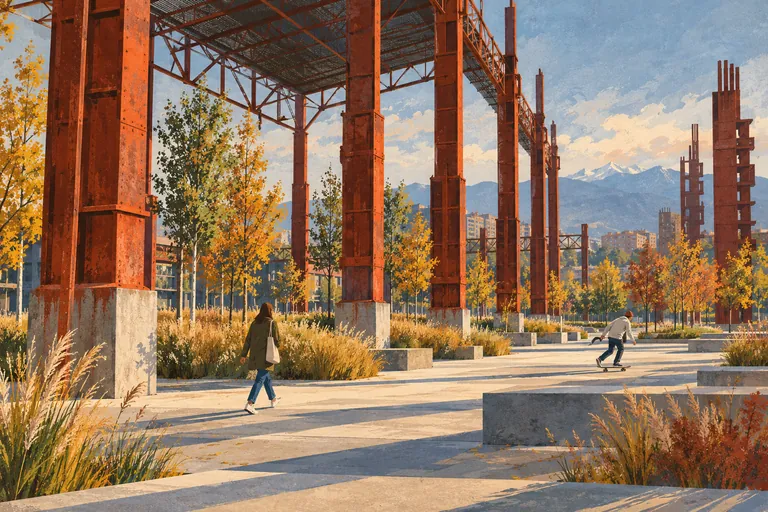
Begin by following the horizontal rhythm of the buildings with your eyes. Where do repeated openings create continuity, and where does a street interrupt it? A planned frontage can give separate buildings the impression of belonging to one large composition. That does not make every doorway a public entrance. Stay on the public route and leave private courtyards and residential spaces to their users.
Try comparing a near view with a more distant one. Close up, individual materials and shopfronts catch your attention. From farther away, the overall outline may become clearer. Neither view is more correct; they answer different questions. This is a pleasant exercise for a companion who is interested in cities but does not particularly want another museum.
Read the monument as an argument
A monument does more than record a name. It selects a story and gives that story a public form. Here the contrast between human figures and a mass of rock makes engineering achievement visible through allegory. You can ask how the arrangement conveys effort, resistance or triumph while keeping the documented subject in view.
That does not require you to accept the monument’s historical message uncritically. Consider whose work a commemorative object names and whose work may remain less visible. This is a question to carry into further research, not an invitation to invent an answer about a particular person. The distinction between interpretation and evidence makes the monument more interesting, not less.
Where do legends fit?
Turin attracts stories about mysterious signs and hidden meanings. A legend can be part of the way a city is talked about, but it should be labelled as a legend. It cannot replace a dated architectural record or establish the original intention of a sculptor. If a guided walk discusses such stories, ask whether it is presenting folklore, documented history or an interpretation.
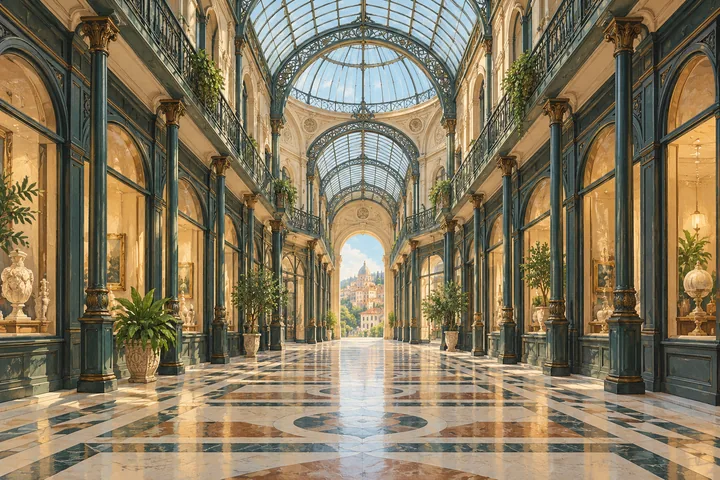
The same discipline helps elsewhere in Turin. Compare Piazza Castello for a different civic setting, or the Galleria Subalpina for a space whose architecture encourages a different rhythm of movement. A square and a covered passage solve different urban problems.
Build a walk around what you want to notice
Choose a manageable route and leave time to stop without standing in anyone’s way. Wet weather, roadworks or a busy crossing may change the most comfortable viewing position. You do not need to circle every side of the monument to have understood something worthwhile. A few precise observations are a better result than a checklist completed while watching the clock.
Our Turin experience collection includes city activities whose routes should be checked individually; Piazza Statuto is included only when the itinerary says so. For a multi-city comparison, Milan’s Piazza Mercanti guide examines another public space shaped by change. Carry the method between cities while letting their histories remain distinct.
Sources & further reading
Turn a good read into a great day.
Find a highly rated Turin experience that brings these stories to life.
Explore related experiences →