Turin’s Santa Cristina: how should you compare a church façade with its interior?

Santa Cristina rewards a second look. From Piazza San Carlo, its façade can seem like one confident announcement: columns, curves and sculpture arranged to command a place in Turin’s great public room. Yet the front, the foundation and the interior belong to different moments. Visiting well means resisting the urge to turn them into a single date. It also means remembering that the building remains a church, whose availability for sightseeing follows a different rhythm from the square outside.
What history can you securely attach to the façade?
MuseoTorino’s historical record places the church’s foundation in 1639, under Cristina of France’s patronage, with Carlo di Castellamonte responsible for the design. Filippo Juvarra’s façade followed in 1715–18. The record also describes twentieth-century interventions, including work connected with the transformation of Via Roma. Those dates give you three useful layers before you have even stepped inside. They do not require you to identify every altered surface, and they certainly do not make every visible detail an untouched survivor of Juvarra’s time.
Start far enough away to take in the whole front without standing in another pedestrian’s path. Follow its horizontal divisions, then the vertical movement of columns and pilasters. Notice how the central portion advances and curves, making a shallow surface feel more animated than a flat wall. An oval opening changes the rhythm again. You need not decide whether this is your favourite Baroque façade; the more interesting question is how the designer directs your attention with a limited strip of urban space.
Why compare the neighbouring church without treating them as twins?
Santa Cristina stands beside San Carlo Borromeo at the southern end of the square. The pairing makes a tempting photograph, but visual companionship does not establish identical construction histories. Compare broad proportions and the way each building meets the street. Then return to Santa Cristina alone. This simple change of scale, from the square to a single doorway, prevents the larger composition from swallowing the particular building. Turin is especially good at teaching this lesson: a coordinated streetscape can contain very different lives.
For another way to practise looking upward, read our guide to San Lorenzo and Guarini’s dome. The point is not to rank architects or collect names. It is to compare the problems they solved: a public front addresses people crossing a square, while an interior can guide attention through enclosure, light and movement.
When is an interior visit realistic?
The official tourism listing, checked on 29 October 2026, gives Tuesday–Sunday morning visiting hours of 09:00–12:00 and says afternoon opening, 15:15–17:30, depends on volunteer availability. It lists Monday as closed for visits. Treat those details as a planning aid, then check again close to arrival. A listed Mass is a service, not an extra sightseeing slot; access during prayer calls for the behaviour of a guest at worship.
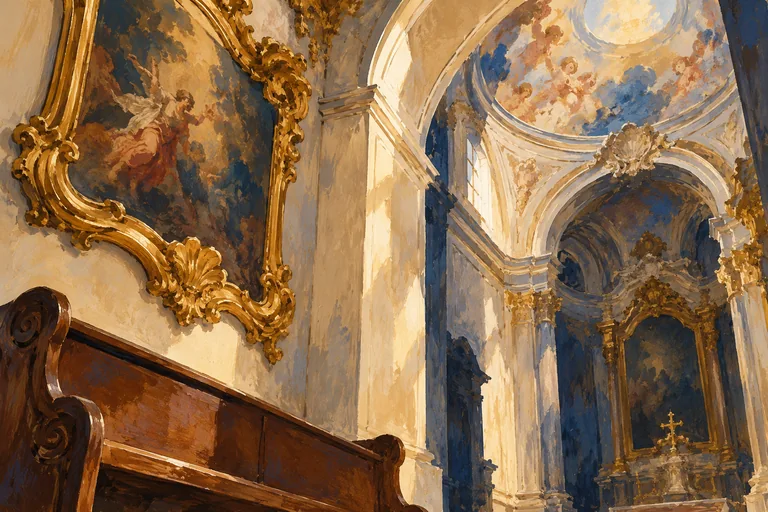
If the doors are open for visitors, pause first. Check for a service, a barrier or a notice before following the visual invitation of an aisle. A quick respectful visit can be more rewarding than a prolonged photographic circuit. Put your phone away for a moment and compare the scale of the room with the façade you have just studied. Does the outside prepare you for the space, or does the transition surprise you? That is an observation you can make without inventing an architectural attribution.
What should you do if the church is closed?
Keep the exterior visit complete in its own right. Walk to another safe viewpoint and look at the relationship between façade, neighbouring buildings and open paving. A closed doorway need not turn into a failed afternoon. Our Consolata guide offers another study in successive periods, while the Cappella dei Mercanti guide explains why checking a small religious building’s opening arrangements matters.
If your journey also includes Lombardy, Milan’s San Maurizio provides a different comparison between architectural divisions and use. Keep each city’s practical arrangements separate. For a guided introduction in Turin, browse the experience collection and inspect the actual itinerary. A general city walk does not automatically include Santa Cristina’s interior, and a guide cannot guarantee a volunteer opening. The best plan leaves room for both a rewarding square and a possible quiet interval inside.
Sources & further reading
Turn a good read into a great day.
Find a highly rated Turin experience that brings these stories to life.
Explore related experiences →