Turin’s San Domenico: how should you read a Gothic church within a changed city?

Turin’s broad streets and ceremonial squares can make its medieval history feel distant. San Domenico offers a different scale of encounter: brick, a lowered interior level and painted surfaces that have survived through substantial changes. A focused visit is most rewarding when you resist treating the church as a perfectly preserved time capsule. Its Gothic character belongs to a building that continued to be used, altered, damaged and restored within a changing city.
Which dates explain what you see?
MuseoTorino records Dominican presence in Turin from the thirteenth century, construction of the church in 1334–1335 and enlargement in 1351. It also identifies substantial restoration around the turn of the twentieth century. Keep the community’s arrival, the construction campaign and the later restoration separate. A religious institution can predate the fabric in front of you, and a medieval-looking surface may include modern intervention.
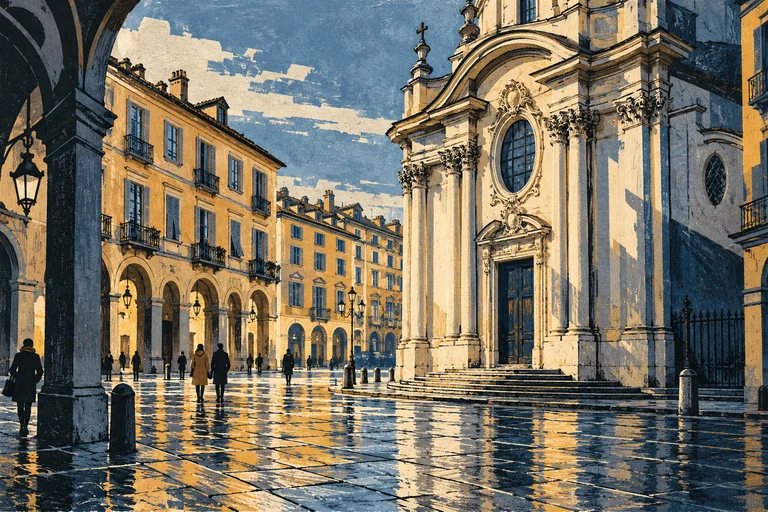
Begin outside with the relation between the doorway and the present pavement. The municipal museum notes that the church floor sits below the current street level. That is an excellent prompt for looking at the city as something built and rebuilt vertically as well as horizontally. It does not mean that every surrounding paving stone or step has a medieval date. Use the visible difference to ask a question, then let documentation establish the chronology.
How should you look at the frescoes?
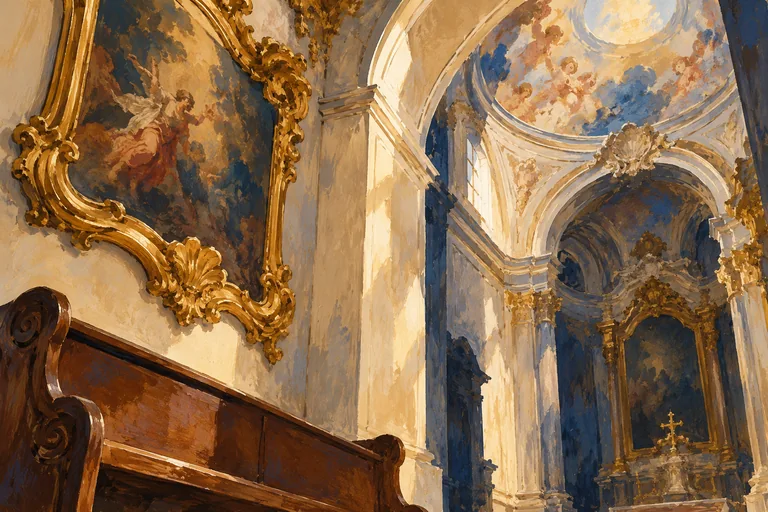
The Cappella delle Grazie preserves fourteenth-century frescoes, including an Annunciation and figures associated with the chapel’s donors. MuseoTorino records restoration and integration of missing portions in 1906. This is an important qualification: the encounter today is with surviving painting and its conservation history, not an untouched surface returned directly from the fourteenth century.
Choose a small area and look at how a figure is framed within the architecture. Can you identify the scene from the available explanation rather than from a quick guess? Notice where your understanding depends on a caption. Do not try to determine original and restored paint solely from colour intensity; changes in lighting, surface condition and treatment can make that approach misleading. A guide or published conservation account can answer questions the eye alone cannot settle.
What has the street changed?
The municipal account describes an eighteenth-century reduction of the church’s nave arrangement in connection with the straightening of Via Milano. It also records wartime roof damage in 1943. Those episodes add a civic history to the religious one: a church can be shaped by street planning and conflict as well as by devotional needs.
Look again from a position that keeps the pavement clear. How does the building meet the street, and where do adjoining structures limit your view? You do not need to find a single “best” angle. A sequence of small views often explains an urban church more honestly than a tightly cropped photograph that removes all its neighbours. Avoid entering adjoining spaces simply because they appear connected to the historic complex.
When is a respectful visit possible?
The Turismo Torino listing, checked for this article, gives a daily pattern of 09:00–12:00 and 16:00–19:00 and separately lists services. Treat those as information to reconfirm, particularly around feast days. An open church is not automatically available for uninterrupted sightseeing during worship, and an advertised service is not a substitute for a cultural visiting appointment.
Enter quietly, follow any local signs and pause if a celebration is taking place. Ask before using a camera, and avoid flash near paintings. If steps or the lower floor level are a concern, contact the church for a description of the usable route rather than assuming that the entrance visible in a photograph tells the whole story. No particular chapel or adjoining room should be treated as guaranteed access without confirmation.
How does San Domenico fit a Turin day?
A short, attentive visit works better than trying to absorb every century at once. Use our guide to Casa del Pingone for another approach to medieval survival, then compare the different architectural questions at the Consolata and San Lorenzo. Plan the actual stops around current access rather than turning those reading connections into a compulsory circuit.
For a separate city comparison, Milan’s San Simpliciano also rewards distinguishing a foundation story from later fabric. Our Turin experience collection lists organised options; verify whether a particular itinerary includes San Domenico and whether it promises an interior visit. The satisfying result is a clearer view of how a medieval church has lived within a modern city, not a claim to have stepped outside time.
Sources & further reading
Turn a good read into a great day.
Find a highly rated Turin experience that brings these stories to life.
Explore related experiences →